
INTRODUCTION
I was born in 1959 and lived in Nottingham until 1980. My parents belonged to a strict religious group. They isolated me from my peers, denying me a social life. To compensate, I would immerse myself in personal projects.
Once a year in July, we took a family holiday in North Wales, a six-day break that was my highlight of the year. Oh, how I looked forward to the drive there and the escape from everyday life! There was no motorway, and it was a long haul along the busy A5. After leaving the trunk road, we drove along leafy lanes. The landscape changed along with the place names. We began to see fewer brick houses and hedgerows, and more stone cottages and drystone walls. After a steep climb through the Berwyn Mountains, we entered a wild landscape. It was windswept, often wet and cloaked in mist. After crossing several more passes, we reached Nantlle in Snowdonia.
Once settled in our caravan, I would escape and be alone, surrounded by rugged hills. I explored streams, quarries, and the woods. I canoed across a lake and imagined myself walking along mountain ridges. I was able to forget about school bullies and my unorthodox lifestyle.
At sixteen, I began a four-year engineering apprenticeship at Brush Switchgear in Loughborough. Before long, I had a motorbike that gave me an escape. One lunch in 1978, during a short trip out, I stumbled upon Charnwood Forest. The stone walls, bracken-covered hills and rocky outcrops thrilled me. It was exactly my type of place!
In 1980, I left home, severing all contact with my parents, and rented a room in Long Whatton. I began to ride in cycle races, and Charnwood Forest was excellent for training. I had also become a keen fell-walker, enjoying many days in the British hills by myself. I won six medals in national cycling competitions, including two golds. I have also climbed all the Scottish Munros.
I have owned a camera since I was thirteen. As I spent more time in the hills, photography became a complementary interest. For many years, I immersed myself in the technical elements of the craft. I owned a lot of expensive equipment and believed I had to travel many miles to find pictures. Needless to say, despite my love of the wilderness, my photographic success rate was low. Today, I have changed and now work on photography projects close to home, using a minimal kit.
I became the Managing Director of a medium-sized manufacturing company. After retiring early in 2020, I began volunteering for the Charnwood Forest Geopark. Being involved in maintaining geological and heritage sites is a great experience. After reminding myself of my first visit to Charnwood, I questioned why I felt such an affinity for the area. I asked myself if this was something that I could explore using photography.
A RELATIONSHIP WITH PLACE
I’ve walked Charnwood's footpaths and cycled along the lanes for 45 years. Despite my knowledge of the area, I had to find a different approach. I needed to stop thinking I knew the area well so that I could see it another way.
I collected an extensive array of books and online articles about the area. I read about Charnwood Forest’s history, geography, geology and natural history. I compiled a comprehensive list of places to explore. These were all locations and things that I could document. But I needed to go beyond this to reflect my emotional connection with the area.
From experience, I know that it’s valuable to have a plan and adequate knowledge of an area. But following a rigid plan leads to creative failure. We cannot always find good compositions or control other things. Far better to be receptive to serendipitous opportunities when they arise.
For a while, I have been curious about Parisian flâneurs during the 19th century. They attempted to experience the modern city by wandering and observing. They aimed to develop a sensory perception of their surroundings. They eschewed hurrying to "get somewhere specific". I remembered Nan Shepherd’s book, The Living Mountain. To appreciate the landscape, she walked “into” rather than “up” the mountain. I have reached the top of almost a thousand hills in Britain. I have proud memories of reaching some difficult summits and the physical endeavour. A different type of experience interested Nan Shepherd. She wanted to absorb and meditate on "the essence of the landscape".
In 1955, Guy Debord invented psychogeographic exploration. This was “the study of the precise laws and specific effects of the geographical environment, consciously organised or not, on the emotions and behaviour of individuals". Psychogeographic practitioners drift through a location, noticing the mundane and discovering the overlooked. They attempt to become aware of their emotional responses.
In my last year of competitive cycling, I was fifty and racing against others in my age group. I knew I couldn’t improve my physical fitness by much, and the idea of training my mind was appealing. I used techniques that helped me let go of expectation and distraction. I imagined doing my best, rather than winning, and I concentrated on the things in my control. It worked; I won a lot of races that year and had a life lesson for the future.
Eugen Herrigel’s book “Zen In The Art of Archery” provides valuable perspectives. As an engineer, I am attracted by equipment and theory. But this does not promote creativity. Being a racing cyclist satisfied my ego, and it gave me the "sense of self" denied by my childhood. But ego has no place in artistic practices. Herrigel sought out a Japanese master of kyūdō. He practised until the technical and physical operations became second nature. By detaching himself from ego and expectation, he entered a state of mindfulness. Then, by finding an "unconscious" state, he gained excellence.
These ideas provide an alternative paradigm for photographic exploration. Any failure involving specific photographic goals results in disappointment. It is better to see every outing as an opportunity to learn and absorb the place. Sometimes it is right to walk in the opposite direction, regardless of the plan. Often, it is better to be aware of and follow our instincts. Detours to look over a wall or walk into scrubland are often worthwhile. The composition that I see when I turn away from my subject is often the best one.
I aim to explore in all seasons and weather, and my mental map of Charnwood is being enriched by experience. Instead of marks on a piece of paper, I have a patchwork of memories. I remember a patch of wild daffodils, winter sunshine on an outcrop of rock, or a veteran oak in a misty wood. By slowing down, I aim to see, rather than look, and to move beyond a perception of the familiar.
A UNIQUE LANDSCAPE
The M1 motorway cuts right across Charnwood, bisecting it from north to south. Before it is out of sight, most people see the area for about eight minutes. Attentive observers may have noticed a few hills, woodland, rocks and some stone walls.
Charnwood Forest is visible from many parts of Leicestershire and beyond. From the south, Bardon Hill punctuates the skyline from miles away. From the north, they appear as a line of hills, often in shadow. At the top of London Rd in Leicester, there is a foreshortened view of Old John, Bradgate Park’s notable hill. Capped with its distinctive viewing tower, it looks much bigger than it is. It is unsurprising that whenever there is sunshine, the city's inhabitants flock to the forest.
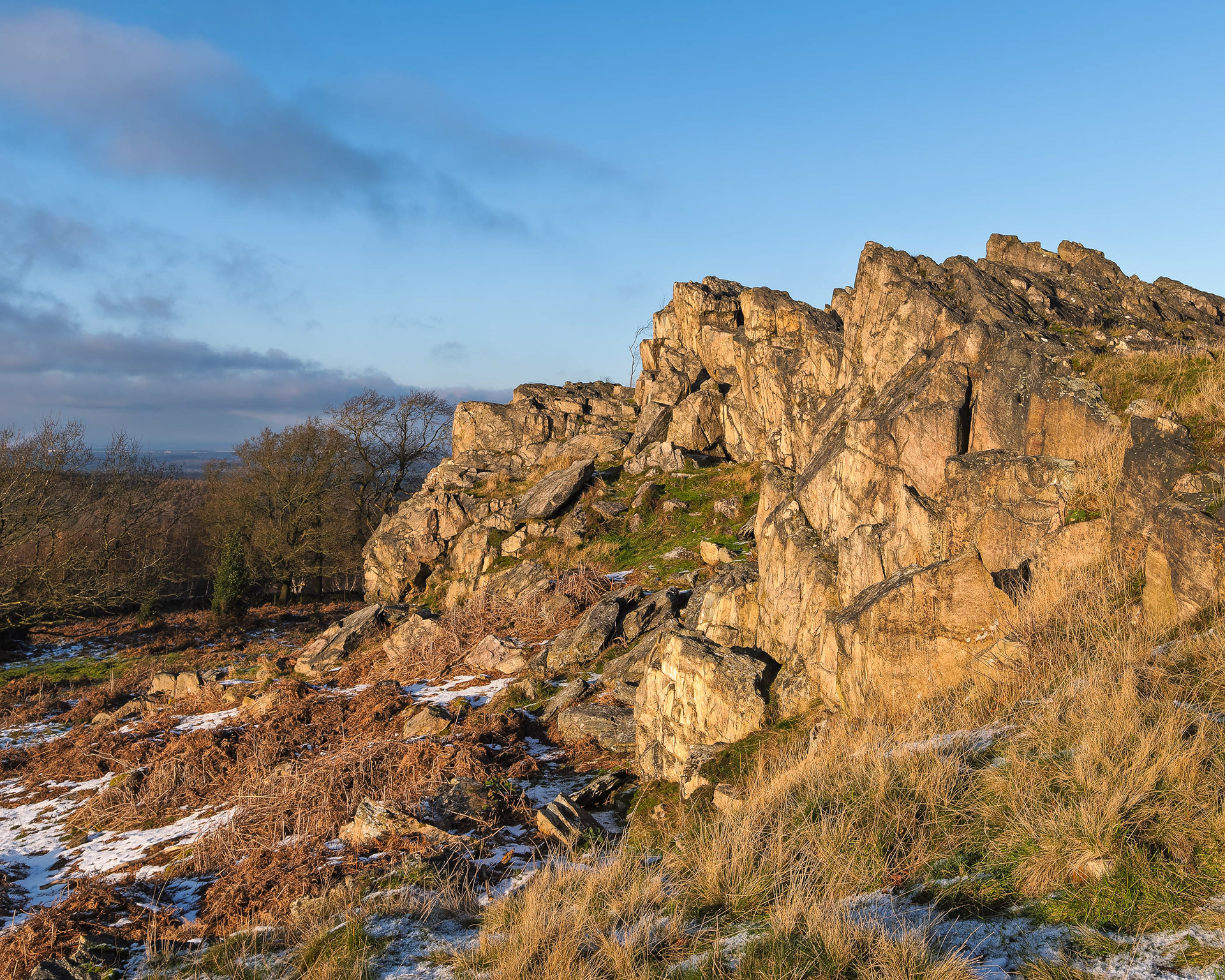
Natural England described Leicestershire as “an open landscape of gentle clay ridges and valleys”. As lovely as it is, there’s not much in the way of dramatic views. Charnwood, with its features that are reminiscent of the British mountains, is special. The volcaniclastic rocks are among the oldest in the country, dating back almost 600 million years. The acidic, stony upland is very different to the surrounding fertile farmland.
Victorian writers extolled the virtues of the area, using particularly flowery descriptions. Spanton wrote of “beauty in the old, grey, storm-beaten rocks, embedded in the mossy turf of brilliant green, enriched with purple heather and the splendour of the ever-blooming gorse, amidst a broad expanse of waving fern! All is redolent of purity and health, disposing us to forgetfulness of sordid care and sorrow, raising the soul that is in harmony with good to higher aspirations.” Potter stated that “invalids are quickly aware of the bracing effect of the forest breezes, and persons affected with asthma find almost instantaneous relief”. He described snow on the “mountain tops” and peaks “hidden in a cap of clouds”. Hollins’ pastoral illustrations depict picnickers in front of exaggerated rocky summits!
In the 17th century, Michael Drayton published Poly-Olbion, a 15,000-line poem. It contains an impassioned description of Charnwood's beauty. This was long before John Ruskin (b. 1819) presented his thoughts about how the mind is influenced what we see in the landscape.
Even when Charnwood had post-ice-age tundra, people were likely to have been around. Mesolithic hunter-gatherers left flint tools by Grace Dieu Brook. Later, Neolithic farmers settled next to the River Soar at Rothley. Stone used to craft polished axe heads came from Windmill Hill at Woodhouse Eaves. Iron Age people established camps at Beacon Hill and Ratby. Over the centuries, Leicestershire became farmland, but not in Charnwood. This sets the area apart from the rest of the county, making it an unusual place.
Most guidebooks describe how the area was once covered in trees. But by the late eighteenth century, the area had become known as Charley Waste. It was a treeless common, grazed by livestock belonging to local villagers. Drovers also made use of it, along with people from other parts of the county. Only a few private enclosures with homesteads existed. Managed rabbit warrens were appearing too, much to the consternation of the villagers. The rocky and nutrient-poor soils suffered from overgrazing, whilst bracken and gorse prospered.
Today we see woodland, pastures, arable fields, stone walls, and scattered farms. At the beginning of the 19th century, population expansion demanded more farmland. In 1807, Parliament received an application for enclosure.
In 1809, the Board of Agriculture received a report on farming practices in Leicestershire. Charnwood had become “quite bare and naked, containing no timber or underwood, nor even the remains, appearances or vestiges of any”. There were also "no deer, nor anything else to give it the appellation of forest, except barrenness, wildness and nakedness.” The conclusion was that it was "worthy of cultivation and improvement.”
An Inclosure Act was finally passed in 1829. The commissioners faced the problem of deciding who had rightful claims to the land. The gentry with influence and outsiders with money did well. Ordinary villagers lost what they considered to be their right. Vernon Davis suggested that the motivation for enclosure was capital gain, rather than a desire to produce food for the nation. Whatever the mix of reasons, the human geography that we see today owes its existence to these events.